

Whether you’re a seasoned Audi owner or jumping in for the first time, this page is meant to provide some insight into market trends, as well as some tips and “been there, done that” style advice to help make the best decisions on the next cars for your collection.
This guide focuses on cars ands trends in the United States for most Audis 1970-1998, and will be updated at minimum every 6 months.
PLEASE NOTE: While I have restored and sold many Audis over the years, the final six vehicles represented for the 2027 Collection are permanent fixtures of T44Brian, and are therefore Not For Sale. Please do not reach out to me with attempts to persuade me to sell: it won’t happen.
New to Old Audis? Read Me First.
A Classic Audi is a great car to experience. But like many of its German and overall European contemporaries, these are cars of a certain age and require a certain long-term commitment that will be littered with ups and downs. When compared to enthusiast favorites such as a W124 Mercedes, E30 BMW, Volvo 240 and even a Saab 900: your most arduous battles will be sourcing parts as well as finding willing mechanics: Let’s start off with some basic ground rules that will either inspire the challenge side of you or come off as poignant warnings that will leave you to admire these cars without signing the title for your own.
- Parts are a Problem: As discussed in the Resources section of the website, Audi has a heritage parts department known as Audi Tradition. As of 2027, the stock is mostly comprised of new old-stock (NOS) parts with some newly manufactured replica parts for common items such as gaskets and badges (NOS parts are labeled “Like New Condition” while replica parts are “Genuine New Produced Part”. Audi of America blocks Audi Tradition purchases to residents of the United States. You must utilize a connection in Canada or another eligible country to order through. Most, if not all US dealers now are unable/unwilling to place orders via Tradition. And while the block used to be more irritating to us US-folk, the sad reality is that after years of “scalpers” and resellers who bought Tradition’s stock to sell at profit, or just the more prolific emergence of 70s-90s modern classic restorations: lots of parts are simply sold out from Tradition and will never likely make a return (there is a toggle to show out of stock items, I would highly recommend not doing that unless you want to feel sad!). Stock of items such as desirable center taillight panels, fresh alloy wheels, and common wear interior pieces have dried up with no known plans for Audi to reproduce anything in particular. Do your best to search for resources outside of Tradition across the world for parts, as well as doing some junkyarding to salvage anything important.
- Plan to DIY: Audi dealers won’t touch these cars, and most independent foreign repair shops are trending to decline jobs on older vehicles in general due to increased liability and lack of parts. From a business standpoint – old cars are fragile, and sometimes that means you encounter seized bolts and break plastic parts that cause roadblocks to get to the actual problem. Shops don’t want to deal with this potential headache. Therefore, you’ll be best served to learn how to do the basics and, over time, more involved jobs to keep labor costs low. Using online resources such as SJM Autotechnik, (what’s left of) Audi forums such as MotorGeek and Quattroworld, and then coughing up about $100-150 to buy a set of Bentley Factory Manuals for your particular car will be the best way to dive in.
- Barn Finds are Not the Best First Experiences: Tying in with parts sourcing issues: buy the best example you can because non-runners and cars that have been neglected will sour your experience quickly. Most of these Audis use some form of Bosch CIS (Continuous Injection System) which, depending on the revision, requires time and precision to sort on a poorly running car. Accident/Salvage Auction cars are hard to rebuild due to lack of body panels and glass, and forest-finds with moss-covered leather and trees growing from the carpets are going to suffer from corrosion, even with galvanization. These cars, however, can be priceless parts cars if you have the space to store them, because you never know what’s going to crumble on the road, or in your hand.
- We’re Still in a Market Bubble: All Radwood-era cars are on the up-and-up, which means it’s going to be a seller’s market for some time. Scarcity will still push prices should the bubble burst, so your days of common $500 deals are permanently gone regardless. Examples I would never touch are going for exorbitant sums on online auction sites (which I have personally dealt with and know the highs and lows of going that route), so don’t equate buy-in cost with perfection. Even the best, lowest mileage cars that have been stored properly and maintained regularly will experience their issues in due time. Plan to have a healthy contingency budget post-sale whether your buying a Sunday driver or planning to daily drive.
COMMON FAILURE POINTS TO LOOK FOR:
- Rust: Audi began galvanizing the bodies of their cars in 1986, but only the C3 chassis vehicles. All 1985 model year vehicles and below, including all B2 cars up to their discontinuation in 1987 are not factory galvanized. Paintwork will destroy the protective qualities of the factory panels, so poor or aging repairs exposed to the elements long term that are rusting are good clues to a non-original finish. Other quality indicators a car was stored improperly or has lurking rust are fasteners in the engine bay and CIS lines, notorious for literally crumbling into pieces over time. You may even want to look for a car that has some of its original cosmoline in the bay and on undercarriage components – its ugly now, but a careful pressure washing usually reveals clean hardware. Audi also added additional foam filler to front fenders sometime in 1990 – and a lot of the 1990 and 1991 C3 cars, including the 20v Avants and Sedans, are notorious for having rusted lower fenders due to the way the additonal foam traps debris that runs off the rain trays. The flared fenders are not easy to source on the 20v cars so make sure to inspect the lower fenders for bubbling and perforation.
- Timing Belts: There is some misinformation regarding which engines are interference and non-interference. To make this as simple as possible: All 2.1/2.2 10v non-turbo 5-cylinder engines are non-interference EXCEPT for the higher compression 2.3 NG/NF motors introduced in 1987. All turbo 10v and 20v 5-cylinder engines are interference, including all the 3.6/4.2 V8s and all 1.6/1.8/2.0 4-cylinder engines. Regardless, that doesn’t mean you should let a belt break even if you’re running a 4000CS quattro or an early 5000. a timing belt job is something to ask about and/or factor into ownership. Audi claims timing belts are good for 5 years or 60,000 miles. I’m guilty of pushing belts on my cars a little farther as most are infrequent drivers and the cars are stored out of the elements. Therefore, a museum piece with a couple thousand miles added a year could realistically see 6-8 years on a belt without taking much of a risk. What is risky is using older belts that may be old stock – rubber tends to have an unused shelf life of about 8 years. Many belt manufacturers are diligent about putting manufacture dates on the belt boxes: so don’t ignore those. Use as fresh of a belt as you can find.
- ABS/Brake Bomb/Power Steering: These are all somewhat tied together, with the hydraulic brake bomb that can fail and cause a BRAKE light in the cluster with a hard pedal, dirty ABS sensors or smashed teeth from poorly done repairs that will trigger a fault and ANTILOCK OFF light, and power steering racks and lines that are not uncommonly already leaking expensive Pentosin mineral oil upon purchase. Inspect power steering reservoirs on C3+/B3+ cars and make sure its not filled with ATF/Power steering fluid. B2s are less problematic as they don’t use Pentosin and have simpler systems.
- Electronic issues: VDO Instrument clusters on later vehicles suffer from cracked solder joints causing dead or jumpy gauges and scrambled AutoCheck displays, window switches are notoriously picky (regulator issues are common as well), burnt out combo switches for turn signals and headlights, electronic climate control units with faults due to bad servos, sunroof motors, and fragile wiring and traces on brake light boards are just a few common irritants of these cars.
- Automatic Transmissions: I’ve actually had good luck with the 3-speed automatics installed in these cars. Granted, I would immediately service them upon purchase and then change the fluid and filters again every 15K miles, which is what Audi recommended. A lot of these cars were scrapped due to transmission issues – so if you’re looking at an automatic, make sure you ask if there’s any service records as to when it was last serviced.
- Brake Master Cylinder: I always keep these on hand because my cars sit a lot, and these master cylinders tend to have a way of seizing up even if you’re on top of brake fluid changes. If you smell hot brakes or notice the car is dragging after its up to temp – the internals of the master cylinder may be shot. Thankfully, these are easy to find for most models still and are under $50.
- Bose-Equipped Vehicles: Bose was optional on 1989-1991 100 sedans, and standard on all US-bound 200 Turbo and 200 20v Sedans and V8s. If you want to keep your original working Audi Delta or Gamma head unit but get popping sounds or no sound at all, your amplifiers need new capacitors. There are 4 amplifiers – two in the front door panel “humps” and in the rear parcel-shelf speaker assemblies. If you want to eliminate the guesswork: these amplifiers are the same used on the C4 Corvettes and sites like Bose Central still refurbish them for a nominal fee. I sent out the cards on my V8 as they did not work upon purchase in 2021 and now 6 years later I still have perfect function from the OEM unit.
- CIS-Woes: Some of the CIS components can be expensive. Earlier versions of CIS used a warm-up regulator which can be cleaned/rebuilt – later versions use EHA valves and various pressure regulators that can also be costly to replace. At minimum, a poor running car should be set correctly first and monitored before replacing components. A lot of times, however, a coolant temp sensor can cause what seems like a CIS issue and is a quick install to rule out any electronic sensor issues.
- Fuel Pumps, Ignition, and Vacuum Lines: These cars will tell you immediately when something is up. Sometimes its a weak fuel pump, sometimes it’s a bad hall sensor in the distributor. And other times it’s just basic vacuum lines. At minimum, I would plan to spend some money and time on refreshing these three items if they’re original and the car has over 100K miles. CAUTION: 20v cars use a specific distributor rotor that has a narrower tip. Using the wrong one can literally destroy your engine. The correct rotor is hard to source, so you can shave a 10v rotor to specification.
- quattro Systems: If you’re buying a quattro-equipped car, make sure the system engages correctly. Earlier cars use a vacuum-actuated knobbed or switch differential system, later cars have a single “DIFF” button, and some cars like the V8 quattro with first gen Torsen have no button.
BUYER’S GUIDE BY GENERATION:
Before you begin reading: Please note that this is a “general” guide for US models. Auction sites and the like provide historical transaction data.
Audi C1 (1970-1977) All
- The First Audis hit the US market in 1970 in two-door and four-door sedan variants. We never received the fastback-style Coupé here. As an aspiring Mercedes competitor, most 100s were trimmed in LS form (rare basic GL models appeared for 1972/73, and then all LS again after 1974) and featured automatic transmissions. Early models received a 1.8 carbureted inline-4 engine, later bumped to 1.9 before going fuel injection-based in 1975. The enthusiast base is small in the States, with few remaining examples. When they do come up for sale, many are projects. Note that fragile automatics and unnecessarily complicated front inboard brakes are deterrents. Outside of a couple outlier examples, expect to pay under $10,000 for a running, driving, and rust free car. Private party deals can be found for around half that cost.
Audi C2 (1978-1983) All
- Audi’s first five cylinder cars were restricted to a four-door sedan model, ROW received less popular two-door sedan and five-door hatch styles, with the hatch being the first car badged as an “Avant” in Audi history. 1978/79 models are identified by quad round headlights. 1980 saw regular square quad sealed beams, and some styling tweaks for both exterior and interior. Available initially in gas and non-turbo diesel (5-speed only) variants, a gas turbo model joined in 1980 and in 1983 a turbo diesel, but turbo cars were only available with 3-speed automatics. Fragile and peculiar with poor parts support, these struggle to achieve high sale values. Low mileage cars are just as picky as well-worn examples. Any model is easily attainable for under $8-9,000 auction/private party.
Audi C3 (1984-1991) 10v Non-Turbo Front-Wheel Drive Sedan/Wagon
- Audi’s bread-and-butter 5000S/100 C3s are all variants on a theme. Offered in sedan and now a full-size station wagon (reminder, Audi did not use “Avant” here until much later to market wagons here and I will refer to these as wagons) 1984’s 2.1, then a slightly revised 2.2 for 1985/85 and finally 1987-1991 2.3 10v 5-cylinder engines were offered. 3-speed automatics are the norm: 5-speed cars are quite rare. Last-run 1991 2.3 cars received a 4-speed 097 transmission. Early cars are easily identifiable by quad sealed beam headlights. 1986 received flush glass headlights and are factory galvanized. A non-turbo CS trim known as the Commemorative Edtition received some equipment from pricier turbo cars for 1986 only. Facelift cars for 1989 switch from 5000 badging to 100 and receive restyled interiors and minor exterior changes. There is also a rare 100E trim that is automatic only, but is the closest thing to “stripper Euro spec” we received for the facelift cars. Values remain low- $5-6000 buys a very nice car. Wagon bodystyles will command a nearly double premium if condition is right: easily $9-10K cars.
Audi C3 (1984-1991) 10v Turbo Front-Wheel Drive Sedan/Wagon and 5000S/100 quattro
- Using a similar setup to the first UrQuattros, a 2.1 turbo engine was found in the first C3 5000S cars for 1984-1985. FWD turbo cars are sedan-only. These cars have unique dashboards and more standard equipment, most notably identified by 6-spoke, 5-lug Aero wheels. In 1986 a revised front unique to turbo models was introduced, and all models offered are dubbed “CS” cars to differentiate non-turbo S cars (outside of the aforementioned Commemorative model). Manual transmissions were standard but quite rare, most are automatics. Revised again for 1989, the newly named “200” Turbo continued as a middle-road sedan model between the base 100 and turbo quattro sedan and wagon. Early models are MC1 (one knock sensor), then MC2 engines (two knock sensors). No 4-speed auto was offered with the turbo for 1991. Although these lack quattro, they do a little better on-market: $7-9000 for a prime example. Expect to pay the same for the lower volume non-turbo quattro 5000S which ran from 1987-1988 and 100 quattro from 1989-1991. You get the benefits of all wheel drive but not much else.
Audi C3 (1984-1991) 10v Turbo quattro Sedan/Wagon
- Beginning in 1986, Audi offered a “flagship” 10v Turbo quattro sedan and Wagon. These are rarer and highly desirable cars, especially the wagons. All are equipped with 5-speed manuals, actuated locking differentials, and generally fully optioned from the factory, outside of signature Pearl White paint and optional Fuchs wheels. 1988s use updated badging and steering wheel as a preview to 1989 cars, but othrwise remain the same. Sedans in nice shape easily fetch $10K, with wagons easily $12-15K.
Audi C3 (1991) 20v Turbo quattro Sedan/Wagon
- The 200 20v Sedan and Wagon (though here I’ll make an exception and call them 200 20v Avants to make sure to differentiate between 10v cars) are the ultimate forms of the C3 chassis. 2.2L 20v 3B-code engines are Motronic managed and produce a stock 217hp. These are popular engines to modify, so aftermarket support is better than 10v cars. Note some may feature pesky stock UFO brakes if not converted to G60s or other kits. 20v cars are easily identifiable by flared fender arches and wider BBS mesh wheels. The accepted number of 20v Avants brought to the states is 149, with arguments for the sedan back and forth between 350 and 900 (though I like to believe 350 is more appropriate given Audi’s US market struggles at the time). Sedans that are stock or well-modified will easily go for $15-20K, and any running and driving 20v Avant that hits auction is easily a $20K car. Some owners (like me) prefer to keep the 20v Avants in the tight-knit enthusiast pool, so you might be able to score on private party for a few thousand less if you know who to talk to.
Audi C4 (1992-1998) 100/A6 All
- If you’re on a budget, these are sometimes the best picks for an aspiring Audi enthusiast. They lack the Rad-charm of the C3 5000/100/200 as well as the 5-cylinder engine: We only got these in 2.8 V6 guise whether you chose FWD or quattro; sedan or wagon. But as a solid german 90s tank, they acceptably hold their own. 1992 models are identifiable by one-year only Zebrano wood. ’93 and later use Elm accents, and for 1995 the 100 name was changed to A6. The sedan was discontinued in 1997 with the introduction of the C5 A6, but the wagon held on for one more model year. The wagons have had a slight uptick in value lately – $7-9K seems to be the auction rate for a quattro 2.8 car. Sedans? Well, they don’t do well on the market. Don’t pay more than a few thousand and don’t expect to get rich off a flip car.
Audi C4 (1992-1995.5) UrS4/UrS6 Sedan and Avant
- Now, this is a completely different story than the 2.8 C4s. Values of these cars are all over the place, but a tastefully modified or stock original can command $15K+. 1992-94 UrS4s are sedan only, 1995 finally received a wagon variant dubbed the UrS6 Avant, and both sedan and wagon 1995.5 models have some changes. Depending on your goals, a 1995 or 1995.5 can hold equal value. I don’t follow these very closely but as with all cars, values are up, and examples that have been looked after and aren’t over 200K miles will command a premium.
Audi D1 (1990-1994) V8 quattro All
- Audi’s first V8 quattro models were offered with a 3.6 engine for 1990/91 and then a 4.2 for 1992-94. All are automatic outside of 71 US-delivered factory manual cars from the first 3.6 run. Fully equipped with options only for extra cost Pearl White paint and choice between comfort or sport seats, these are notoriously loved cars but also notoriously a pain to get parts for. While it looks like a regular 100/200, not much is shared between them. While it does feature a desirable Torsen quattro (sometimes pulled for upgrading 200 20vs) the automatic transmission does hamper its value to some. Expect to pay $8,000 for a complete car and potentially double for a manual or pristine example on the auction circuit.
Audi B1 (1973-1979) All
- Other markets knew it as the 80, but we got it as the Fox. Two-door and four-door sedans are most common with a wagon variant also offered (a 5-door hatch was offered as the VW Dasher in the states). Some special variants were available through the run, including a Fox GTI for 1978/79 which came in two-door sedan with vinyl graphics and unique interior appointments. These are around but tough to find in complete running condition. Expect to pay anywhere from $5-10K if a Fox is a must-have for your garage.
Audi B2 (1980-1987) non-quattro 4000/Coupe GT All
- The “4000” appeared in the US for the 1980 model year. A wagon variant was not offered this time around; just 2-and-4 door sedan. Early examples are very much “Fox+” with some trim and interior updates. After ditching the carry-over wheel covers and getting some additional tweaks in 1981 and 1982, these were finally separated from their B1 brethren. Gas and diesel models were sold, and a 4000 5+5 2-door is a highly collectable piece to B2 enthusiasts. Joining the US lineup for late 1981 was the Coupe GT – which came with a 2.1 5-cylinder engine as standard equipment. A special build 1984 Oceanic 4000S sedan appeared with some equipment that would be seen in the 1985 facelift. Early 4000 and Coupe GT models span a large price range, with some examples reaching $30K for Ingolstadt-museum quality specimen. But realistically, expect to pay less than $10K for any early B2. In Europe/ROW the Coupe GT received a quattro variant, but even for the 1985 facelift, the car remained a FWD, 2.2 10v non-turbo offering. A 1987 “Special Build” example received the new 2.3 I5 which produced 130hp. Values still remain low, but a manual equipped facelift Coupe GT can command $10K+ with no rust and low mileage. The same can’t be said for the facelift 4000S, which retains a 1.8 4-cylinder engine and unsurprisingly were mated with 3-speed autos. Values remain lower for these sedan variants even in good shape.
Audi B2 (1984, 1985-87) 4000S/CS quattro
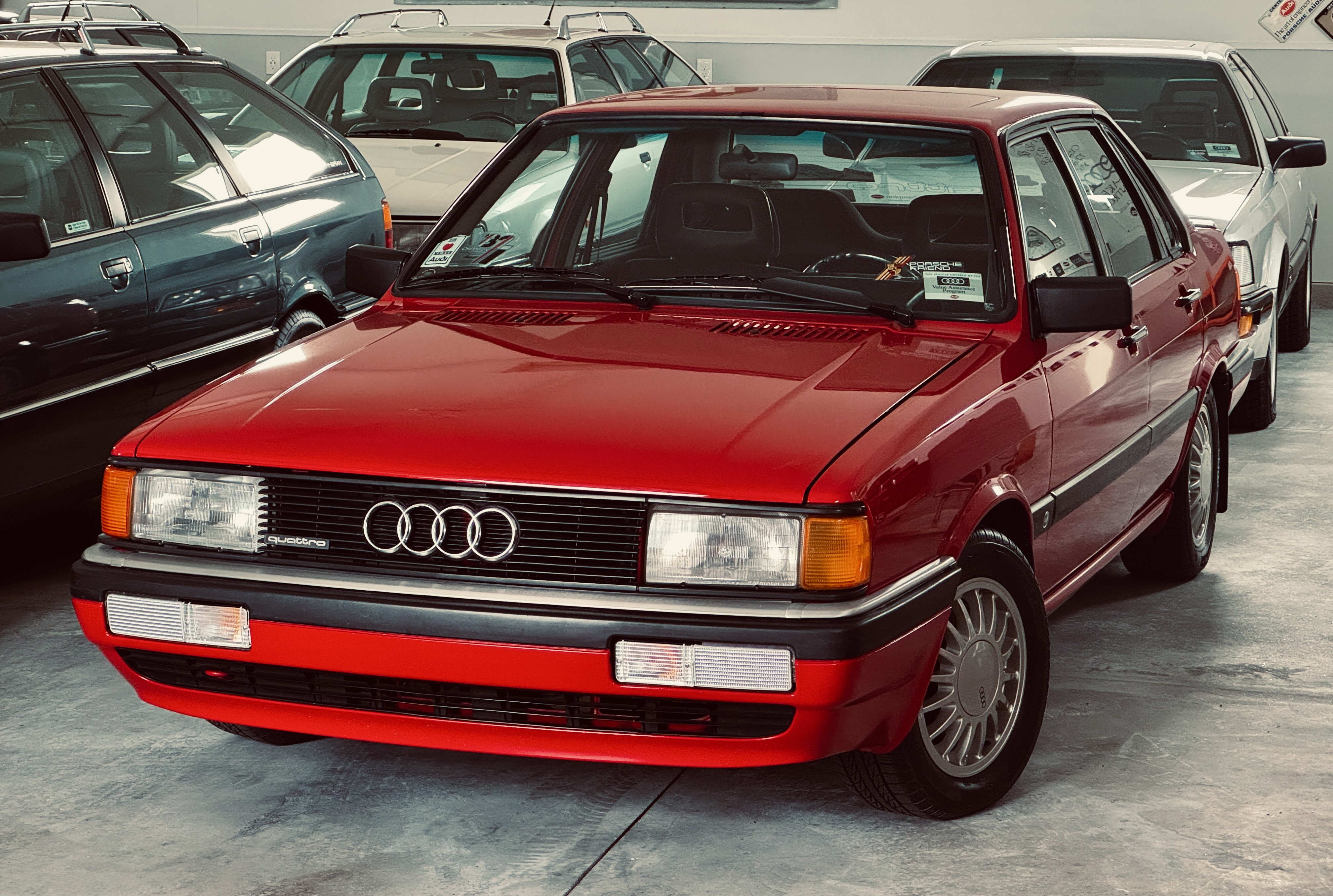
- Be still my heart, for this Large Chassis guy loves a proper facelift B2 4000S/CS quattro. The market tends to agree with me on this one: values are always on the up-and-up for a 4000 quattro. 1984 was the first proper 4000 quattro, using the 2.2L JT 5-clyinder engine. 1985 introduced a facelift to the 4000 line, which brought the look more in-line with the newly introduced 5000 cars, notably receiving flush headlights first before the ’86 5000 update, and a freshened interior which is of significantly higher quality and more durable than earlier cars. The 4000S quattro turned into the 4000CS quattro for 1986 until it’s discontinuation in 1987 to differentiate between FWD 4-cylinder 4000S cars. 1987 models are “Special Build” in the same vein as Coupe GTs, but are still married to 2.2 engines. These cars are Tornado Red or Alpine White with body colored mirrors, black badges, a trip computer standard, and heated quattro-script Satin Jacquard seats. I’ve received offers for $30K for my ’85, but the market is around $20-22K for a solid 4-door 4000S/CS quattro.
Audi B2 (1980-1985) UrQuattro All
- I’m no expert on the UrQs because I avoid them. Why? I’m a 4-door guy, and a 4000 is a priceless piece to me compared to any Ur-Quattro. We officially received them as 1983 model-year cars, and then up to 1985 with various changes each year. If you get lucky, a “project” car will run you $20k, and a clean, unmolested example can fetch $50-70K. These cars are also popular candidates for 3B 20v swaps and the like, and those cars with non-original engines start around $45K and go into the $70-90K range if they’re done correctly. We won’t talk about the “RR” Quattro versions sold overseas here, but some have made it over to the States and those are very high-dollar cars.
Audi B3 (1988-1991) 10v 80/90 All
- I’ve only owned one B3 – a very rare “shouldn’t be here” spec 80 in Papyrus with Sepia brown velour interior. The B3 is the size of a 4000 with 5000/100/200 appointments, so if you like a smaller car, you’ll easily warm up to them. The B3 went on sale in 1986 in ROW and 1988 in North America. While there were small changes to the cars throughout the years, early 80s are 2.0 4-cylinder FWD cars, with the quattro versions mandatorily attached to the 2.3 5-clyinder and 5-speed manual. 1990 80 cars saw painted bumpers and a few mods, but the formula stayed the same. 90 cars always had painted bumpers and higher trim equipment. Some early 90s in 1988 had 4-cylinders, but later 90 cars in FWD were all 5-cylinder regardless of transmission chose. Values struggle on non-quattro cars, but a clean 80/90 10v will run you $5-9,000.
Audi B3 (1990-1991) 20v 90 quattro and Coupe Quattro
- Like the 200 20v Sedans and Avants, the B3 90 20v quattro are in their own league and considered the pinnacle of their chassis. A low-production model for the US, they’re hard to find clean, and will command a premium over their 10v 80/90 peers. On similar terms is the B3 Coupe Quattro, offered here for 1990 and 1991. Expect to pay $12-15K at minumum for a good example of a Coupe Quattro or a 90 20v quattro. A small reminder that these use the “7A” engines which are not turbo’d like the 3B 200s, but mods can make these quite the rockets.
Audi B4 (1993-1998) All
- In the same way the 2.8 C4 cars get grouped together, these B4s are sometimes tossed to the side but are a good value if you’re willing to drive a V6 instead of a 5-cylinder. The B4 has a slightly longer wheelbase than the B3 80/90 but essentially retains the same interior and drivetrain appointments. We did not receive the Avant version, and I will not cover the S2/RS2 Avant or 91-96 Coupe here because, well, it’s out of my scope for this purpose. The highlight of this generation is the late-run 90 Sport Quattro which, like final year B2 4000s, gets a couple unique touches such as quattro-Script seats and modifications to gauges/suspension. Values remain below $8k for any variant of this generation.
Have something to debate or add to this list? Feel free to reach out to me via Instagram or eMail. I’m always open to updates and suggestions.
